
The Fashion Forecast | Chanel Spring-Summer 2027 Act 1,
Paris Fashion Week · Spring/Summer 2027
Matthieu Blazy titled it La Conversation, Part Three: Different Faces of the Same Coin and called it the women within a woman. I call it the house going back to the archive and coming out simple and sharp. Here is what that means for your closet, your consignment pile, and the flap you almost sold.
I have been a Chanel client since I was a little girl. My grandmother was incredibly chic, and she introduced me to the top houses at the age of two. Some children watched cartoons; I watched runway shows. Art and pop culture came after that, in that order, which tells you everything about how I was raised. So it makes sense that this house and I have been together since the beginning. I learned it the way you learn a language at home rather than in a classroom, and when I say this collection felt like coming home, I do not mean it was nostalgic. Nostalgia is soft. This was not soft. This was the house opening the drawers it has always had and deciding, finally, that the originals were the point.
The word I kept writing in my notes was archive. Not references, not winks. Archive. The collection reached back to the 1920s and pulled forward a century of its own ideas, then edited them down to something simple and sharp. If you have been reading The Edit this season, you know I have been tracking this across Milan and Paris: the houses are not inventing right now. They are remembering. Chanel just did it with the most to remember.
The Women Within a Woman
Blazy's theme, and why it is the only one that makes sense.
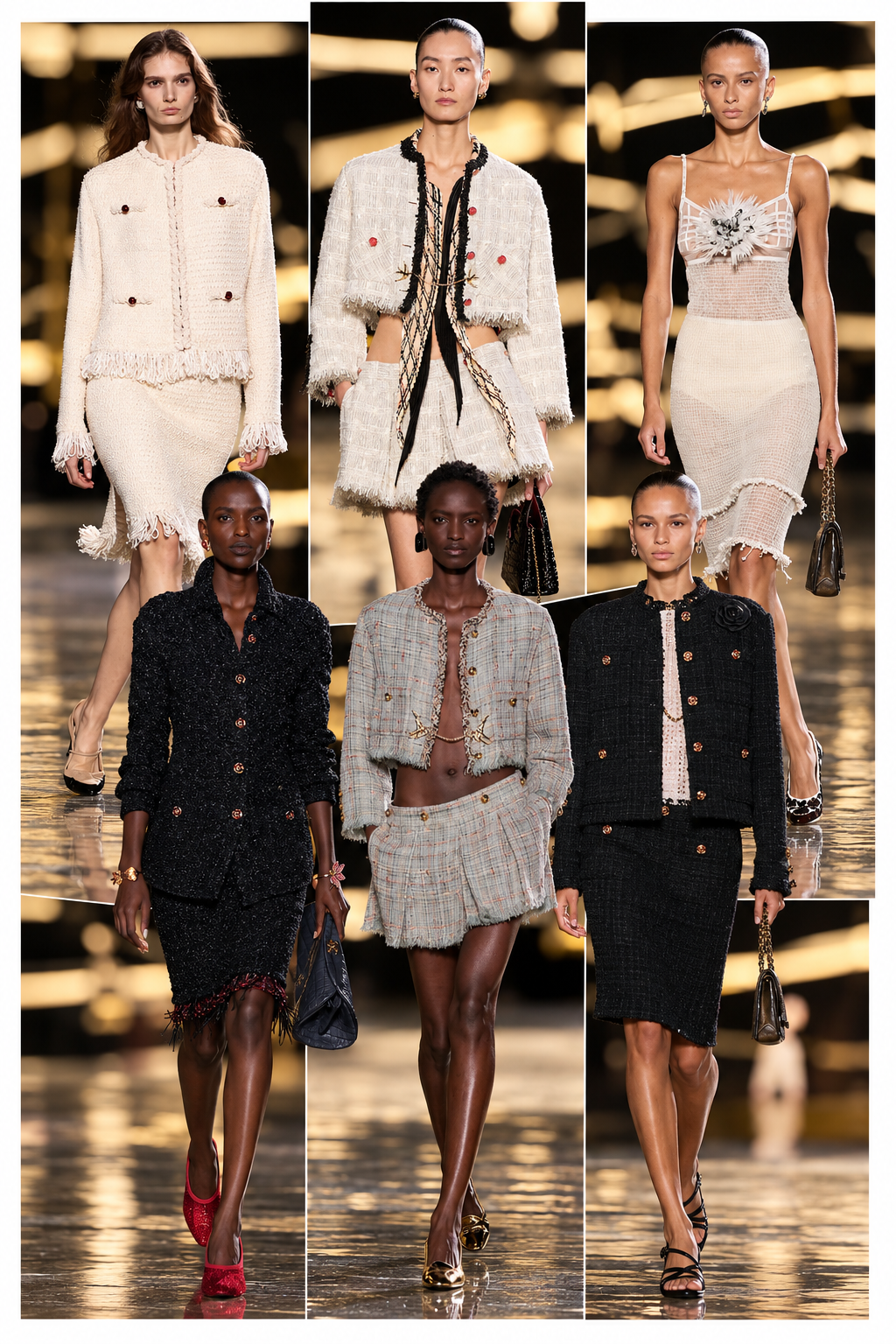
The house gave the collection a name, and for once I am not going to argue with it. The women within a woman. Matthieu Blazy built the show around Gabrielle Chanel's many selves and the arc of her own closet: the Edwardian corsetry she was laced into as a girl and spent the rest of her life rebelling against, the men's suiting she borrowed and reconfigured until it was hers, the clothes she wanted you to slip on and barely notice you were wearing. Silhouettes transformed on the runway the way a woman transforms across a life, and the new idea at the center of it was a smocked tweed, built for movement, so the most structured fabric in the house's vocabulary finally gave.
I have spent twenty years dressing women who are several women at once. The one who runs the meeting and the one who leaves it for a school pickup. The one who wants the jacket and the one who wants to take it off by nine. Every client I have ever had has been a closet full of selves, and the ones who dress well are the ones who stopped choosing between them. That is what this collection understood. A woman does not graduate out of her twenties self or her corsetry self; she keeps them, and she keeps the clothes. Which, if you have read anything I have ever written, is the entire argument for the archive. Your walk-in is your portfolio because it holds every woman you have been, and the good pieces are the ones that let the next one through.
◆
The Twenties, Again
A swallow, a chain, and a hem that moves.
The clearest thread ran straight to the decade the house found its codes. Mademoiselle opened her doors on rue Cambon in 1910, but the 1920s were when the ideas that still define the house arrived, No. 5 in 1921, the little black dress in 1926, and this collection went straight to that drawer. A new swallow symbol appeared on buttons, embroidery and jewelry, including a swallow chain closure, and to my eye it reads as a direct ode to the 1920s, the kind of small, specific detail that collectors will be hunting in ten years. Delicate chains ran through everything. Hems were fringed and beaded, so that the simplest column dress moved like it was 1926 and the band had just started. Iridescent dresses caught the light the way the original silk charmeuse did. And the little black dress, the house's own 1926 invention, came back elevated, which is the only direction it has ever needed to go. And pearls, always pearls, but layered now, strand on strand, the way Mademoiselle actually wore them rather than the way the costume department thinks she did.
There was also a phrase I kept coming back to: wearable art. Suits that were sculpture you could sit down in. A bigger, bolder tweed print worked through several iterations. This is the house reminding us that the tweed jacket was never a uniform. It was a canvas.
For the archive shopper, this is your moment. Original 1920s Chanel is museum territory, but the beaded and fringed evening pieces from the 1980s and 1990s, when Karl was quoting the same decade, are very findable, and they just became current again. Look for the fringed-hem evening jackets and the beaded camisoles. If you want the look without the hunt, a beaded fringe slip gets you ninety percent of the way there this season.
The Suit, Rewritten
Delicate, chained, and borrowed from the boys.
If the twenties gave the collection its soul, the suiting gave it its spine. The tailoring was delicate, almost weightless, that smocked tweed moving like jersey, with the signature chain moved out of the jacket lining and onto the vest, where you can see it. Chain ran along the hems of skirts and jackets with a new fringe motif, so the thing that used to be a secret weighting trick became ornament. I wrote a whole piece on the chain that holds the Chanel suit together; this season the house wrote it on the outside.
Menswear was layered into the women's suiting in a way that felt correct rather than clever: a man's waistcoat under a tweed jacket, trousers cut with a little more room. And then the opposite move, the cropped jacket worn open over nothing at all, a swallow pinned at the lapel, which is the most Gabrielle idea in the show. The buttons were jewels, garnet and gold, on nearly every jacket. Tweed minis were everywhere, and tweed shorts beside them. Outerwear mixed print with tweed, which is harder than it sounds and the house made it look inevitable. And a deep navy tweed showed up that I would put against any black in your closet.
The chain used to be the secret. This season the house wore it on the outside.
The portfolio read here is simple. A vintage Chanel jacket has always been a blue-chip hold. A vintage Chanel jacket with a visible chain hem, from any decade, just got a current-season hook. If you have one on consignment with me, I am not lowering the price. If you are shopping, the cropped tweed jackets of the early 1990s are the sweet spot, and a menswear vest under it is the fastest way to make it look like you saw the show.
The Nineties and the Aughts
Sheer straps, wide belts, and a square toe I never gave up on.
Sheer dressing was the other half of the story, and it was done with restraint. Sheer spaghetti straps, very 1990s, held up dresses that otherwise did nothing to call attention to themselves, which is exactly why they will sell. Layered and drop-waist skirts, which I have been telling clients to keep for two seasons now, are officially here to stay, and the waist kept dropping: low-rise, with maxi lengths to balance it, the proportion every woman who was out in 1997 already knows how to wear. Wide belts came back with their nineties proportions intact, and they are the thing that makes a low rise look decided rather than accidental. And then the shoes: a block, square-toe pump straight out of the early 2000s, the shoe I have been quietly wearing and quietly defending for years.
There was one gown I can only call whimsical, and I say that as a compliment. It had the line of a thirties evening dress, bias and unbothered, and in a collection this disciplined, one piece that dreams is a reminder that the house still knows how.
If your closet has a 1990s Chanel slip, a camisole, a chain-strap evening bag from that decade, do not consign it this year. Wear it. If you are buying, vintage Chanel slips and camisoles are still priced like pieces no one is looking for. They will not be for long. For the shoe, a block square-toe pump is the single most useful purchase you can make for spring, and a wide leather belt will do more for a drop-waist skirt than any other accessory in the room.
The Palette
Crimson against the sky.
Chanel does not usually get credit for color, which is a mistake. This season the palette was crimson, neutrals, emerald and gold on one side, and on the other a run of sheer blues the color of a clear sky with pale pink beside it. Deep navy and a surprising yellow rounded it out. The pairing to steal is navy with pale pink. The pairing to invest in is emerald with gold, because that is also exactly what the jewelry case looks like.
The Bags
The flap is back. The original flap.
Here is the headline for anyone who follows the resale market. The vintage classic flap is back, reimagined so close to the original that from ten feet you would not know which decade you were looking at. There was a new take on the raffia classic flap in a medium size, in a blue and a pale pink that felt made for a June wedding. Pearl-detail straps appeared. The CC embellishment went giant. New iterations of the lucky charm turned up, and the camellia, reimagined, continues, as it always does. Two newcomers for the record: a soft cloud-shaped bag and a birdcage minaudière, the swallow's little joke on us all.
When a house reissues its own vintage almost exactly, two things happen. The new version sells out, and the original becomes the smarter buy, because now it is both the reference and the rarer object. I watched it happen when Karl brought back the 2.55 in 2005 for its fiftieth anniversary, and the archival 2.55 opened and closed this show, so the house knows exactly what it is doing. If you own a vintage classic flap, especially a 1990s lambskin in black with gold hardware, hold it. If you have been waiting to buy one, the window before the market catches up is open right now, and it is not a wide one.
Pro tip
Pearl straps and lucky charms are the two details most likely to trickle down to the costume jewelry case. The Jeweled Box has vintage pearl strands and charm pieces from the house's earlier seasons, and they are priced for wearing, not for a vitrine.
When it lands
This collection arrives in boutiques in two acts: Act 1 in January and February, tagged 27P, and Act 2 in March and April, tagged 27S. That letter after the year is how you read a Chanel tag on the resale market, P and S for spring, A and B for fall, C for cruise, K for Métiers d'Art. When 27P starts showing up on consignment next spring, you will know exactly what you are looking at.
What This Means for Your Portfolio
Hold, buy, wear.
- Hold your vintage classic flaps, chain-hem jackets, and anything 1990s with a thin strap. The house just made your case for you.
- Buy archival costume jewelry: layered pearls, oversized earrings, charm pieces. When the new pieces look vintage, the real vintage wins.
- Buy the early-2000s square-toe pump and a nineties wide belt. Low cost, high translation, and they will carry a low-rise maxi or a drop-waist skirt through the whole season.
- Wear navy with pale pink, emerald with gold. Color is the cheapest way to look like you were in the room.
- Consign what no longer fits the story. The market for Chanel is strong right now, and strong markets are when you trim.
The house went back to its own beginning and found every woman it had ever been was still there. So is yours, if you built the closet right.
◆ ◆ ◆Worth keeping forever.